
How Google Translate Exposed Russias Secret Army
A joint investigation by The Insider and Der Spiegel traces how a free translation app routing messages through servers in California undid Russias most secretive assassination unit, Center 795
On February 24, 2026, Denis Alimov landed at El Dorado International Airport in Bogotá looking like a middle-aged Russian tourist escaping Moscow's winter. Colombian border officers had him in handcuffs within minutes.
Alimov, 42, was a decorated FSB Alfa special forces veteran. Since 2023 he had been a senior operative in Center 795 — Russia's newest and most secretive assassination directorate, designed to be "impossible to detect." He was caught because the FBI had been reading, for over a year, the Google Translate–assisted exchanges between him and one of his would-be foreign assassins.
This is a summary and analysis of the joint investigation by The Insider and Der Spiegel (June 2026), also covered in the video by The Christo Files.
The summary in one paragraph
Russia's most secretive assassination unit — built from the ashes of the burned 29155, camouflaged inside the Kalashnikov Concern, staffed by 500+ elite operatives, and funded by oligarchs — was undone not by a mole or a signals intercept, but by a free translation app that routed its operational messages through servers in California.
What happened
Between 2018 and 2022, the GRU's Unit 29155 — responsible for the Salisbury nerve-agent attack, the Montenegro coup attempt, and a string of assassinations across Europe — became "a liability." Its officers were identified by name, photo, and passport number.
Moscow's answer was not to disband it, but to create a rival. In December 2022, a General Staff order established Military Unit 75127 / Center 795, a wholly separate structure reporting directly to the Chief of the General Staff. Its mandate: "full-cycle" operations — intelligence, surveillance, sabotage, and killing — in a single, self-contained command.
The unit was embedded inside the Kalashnikov Concern at the "Patriot Park" complex, staffed by 500+ operatives from the FSB, GRU, and FSO, and divided into three directorates:
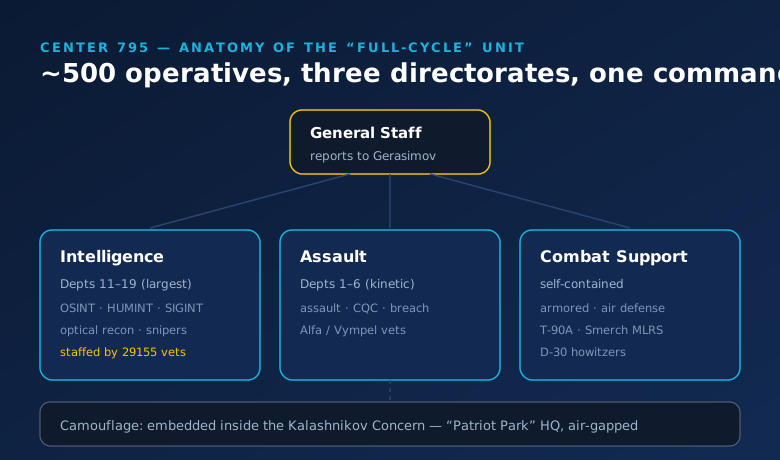
A PowerPoint presentation prepared for Kremlin sponsors — infographics, org charts, icons of tanks and drones — was obtained by Western intelligence and journalists within months, revealing the unit's full structure.
The fatal language gap
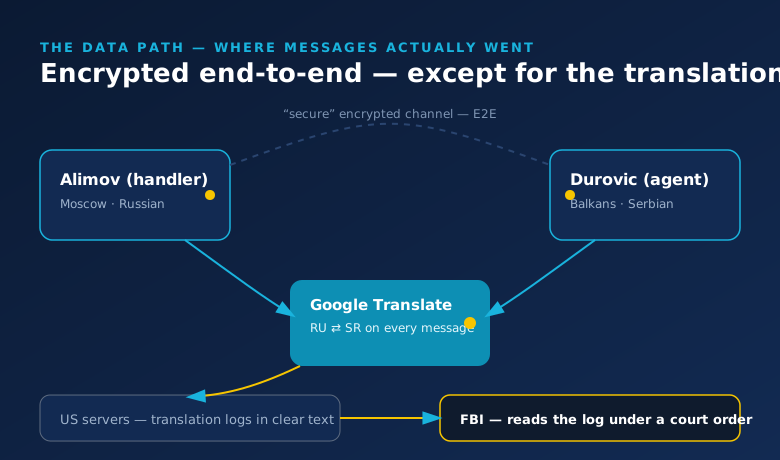
The operational failure had a specific shape. One of Alimov's agents was Durovic, a Montenegrin MMA fighter recruited for a $1.5 million murder-for-hire plot targeting two Chechen dissidents in Europe. Durovic spoke Serbian. Alimov spoke Russian.
Their solution: Google Translate — converting Durovic's Serbian field reports into Russian, and Alimov's instructions back into Serbian. The messages themselves went through encrypted applications the men believed to be secure.
But Google operates through servers in the United States, which fall within the reach of an FBI surveillance warrant. With a court order, investigators read the clear-text translation logs directly from the service provider — the entire operational communications thread, in real time, while Alimov and Durovic believed themselves protected by end-to-end encryption.
The analysis
1. The unit was designed to be undetectable — and it failed at the most basic level.
The entire architecture — separate command, corporate camouflage, elite staffing, air-gapped HQ — was built to resist the specific failure modes that burned 29155: open-source exposure, biometric identification, financial trails. None of those defenses matter when the operational channel itself is a consumer app. The unit solved the hard problems and ignored the easy one.
2. The translation step was the single point of failure.
The encrypted channel was sound. The problem was not the encryption — it was the step outside the encryption boundary. Google Translate is not part of the secure channel; it is a third-party service that ingests the plaintext and returns a translation. The FBI did not break any encryption. It simply read the log of what was sent to the translation service.
3. The "idiotic lapse in tradecraft" framing is fair but incomplete.
It is easy to blame Alimov and Durovic for using a free app. But the deeper issue is a capability gap: the unit was staffed with elite combat operators, not with linguists or secure-communications specialists. The language gap between a Serbian agent and a Russian handler was a structural problem with an obvious, low-tech solution — and they used the one that was easiest, not the one that was secure. That is a training and resourcing failure, not just a human error.
4. The broader lesson for any security architecture.
The weakest link in a chain is rarely the most sophisticated component. It is the step where the system touches the outside world for convenience. In this case, that was a translation app. In a corporate context, it would be a cloud SaaS tool, a shared document editor, or an email forward to a personal account. The principle is the same: the boundary you do not control is the boundary that will be exploited.
What this means
For anyone building secure systems — in government, in finance, in any high-stakes environment — the takeaway is not "never use Google Translate." It is: know where your data actually goes, even in the steps you think are incidental. The encryption was fine. The architecture was sound. The one step outside the perimeter was the one that mattered.
Our solution for this exact problem
This is the precise failure mode our AI-Translator & Documentologist product was built to eliminate. It runs an offline LLM on your own server — RU, KZ and EN translation of official documents with nothing ever sent to an external service. No Google Translate step, no foreign servers, no log a prosecutor can subpoena.
- Fully offline: the model runs on your hardware; data never leaves the perimeter
- Official-style RU ↔ KZ translation, trained on administrative and legal language
- Batch processing of hundreds of documents with a review queue
- Incoming-mail classification and routing to the right department
See the product → ALDIS Translator
---
Sources:
- The Insider: Lost in translation: How Russia's new elite hit squad was compromised by an idiotic lapse in tradecraft
- Der Spiegel: Putin's New Elite Unit — Exposed
- The Christo Files (YouTube): How Google Translate Exposed Russia's Secret Army
This article is general information, not legal advice. Check the current edition of each act before relying on it.
Discuss your case
We run a 30-minute session on your data landscape and regulatory constraints.
All articles
How to deploy AI in a bank without sending data to the cloud
Why public LLMs fail compliance in Kazakhstan's banks, and what an on-premise AI architecture that passes looks like: models, infrastructure, access control, audit.
Decree No. 832 and the AI Law: a buyer's checklist for an AI system
Which requirements of Kazakhstan's Unified Requirements for ICT and information security (Decree No. 832) and the Law on Artificial Intelligence apply to a corporate AI system, and how to verify them before acceptance.